
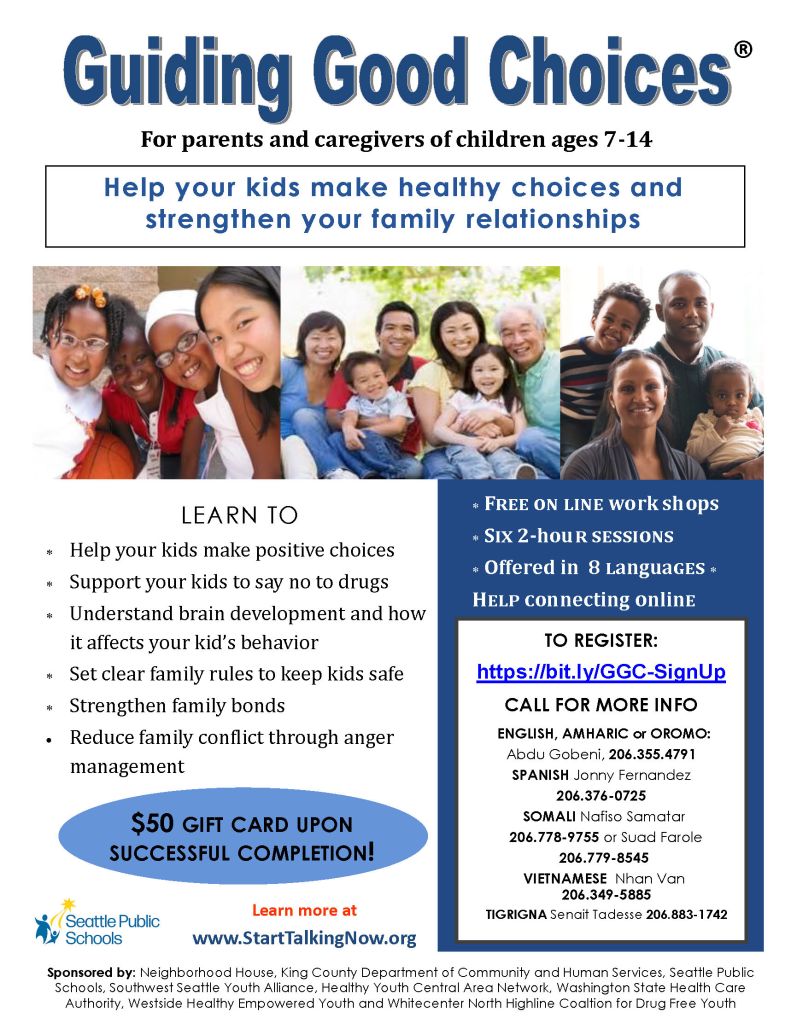
Guiding Good Choices
We are currently enrolling, if you are interested in another language please fill out the form below or call the number on the flyer to sign up for future sessions. All sessions are online at this time.
Anyone can sign themselves up or sign someone else up with this registration link: https://bit.ly/GGC-SignUp

Fostering a Lifelong Love of Learning: Parental Strategies That Work
In today’s rapidly evolving world, fostering a love for education in children is more crucial than ever. This guide provides practical, engaging strategies to help your children embrace education with enthusiasm. By integrating technology, creativity, and real-world experiences, you can make learning a joyous part of their everyday lives. Courtesy of Seattle Public Schools, here’s how to support your child’s educational journey and inspire a lifelong passion for learning.
Harnessing Technology and Creativity
In an age where technology permeates every aspect of life, educational apps and custom games become invaluable tools in making learning both fun and engaging. These resources allow for a personalized approach, catering to your child’s interests and pace. They transform traditional subjects into interactive experiences, encouraging exploration and deepening understanding. Integrating these tools into your child’s routine can significantly enhance their excitement about learning.
Projects Aligned with Passions
Encouraging your children to engage in projects that resonate with their personal interests can significantly boost their learning motivation. Whether it’s a science experiment, a history presentation, or a creative art piece, these projects allow them to explore subjects in depth, applying what they learn in a tangible way. This hands-on approach not only reinforces their knowledge but also demonstrates the value and applicability of their education.
Leading by Example
To inspire your children’s love for learning, it’s crucial to model curiosity and passion for knowledge yourself. If you’ve contemplated furthering your education, enrolling in an online degree program offers the flexibility to achieve your goals without compromising other commitments. For instance, you might have considered learning more about relationships and how we respond to life to improve your parenting. By pursuing a psychology degree online, you not only enrich your understanding of human behavior but also set a powerful example for your children, showing them the value of lifelong education.
Taking Trips
Regular visits to museums, science centers, historical sites, and nature parks offer rich, experiential learning opportunities. These outings make abstract concepts tangible, allowing children to see, touch, and interact with the subjects they’ve only read about. Experiencing the wonders of science, art, and history first-hand sparks curiosity and deepens their understanding, making education a thrilling adventure.
Cultivating a Love of Reading
Setting aside time for family reading, organizing library visits, and starting a book club are excellent ways to instill a love for reading. These activities not only improve literacy skills but also open up new worlds of imagination and knowledge. Reading together fosters a shared learning experience, strengthening bonds and encouraging a lifelong habit of reading.
Connecting Learning to the Real World
Showing your children the real-world applications of their studies bridges the gap between theory and practice. Whether it’s cooking to learn about measurements and chemistry or budgeting to understand math, practical applications make learning relevant. This approach helps children appreciate the usefulness of their education, encouraging them to engage more deeply with their studies.
Nurturing an Environment of Curiosity
Creating a home environment where questions are encouraged and curiosity is celebrated can profoundly impact your child’s approach to learning. By valuing inquiry and exploration, you foster a mindset that views education not as a chore but as an exciting journey of discovery. This openness to learning encourages children to seek knowledge actively, both inside and outside the classroom.
Cultivating a love for learning in your children is a rewarding journey that requires creativity, patience, and involvement. By embracing the strategies outlined above, you can transform your child’s education into an engaging, enjoyable experience with a lifetime of benefits. Remember, the goal isn’t just academic success but nurturing curious, well-rounded individuals with a lifelong passion for learning.
For information, events, and resources for parents and students, visit Seattle Public Schools online today!

6 Out-of-the-Box Activities for Kids to Do After School
After-school activities for kids are a dime a dozen. But a run-of-the-mill activity like playing tag or watching TV isn’t exactly going to help your child develop and grow. You could, instead, encourage them to pursue activities that benefit their development in some way while being fun at the same time. Below, Seattle Public Schools offers seven out-of-the-box activities your kids can do after school:
Learning a Second Language
Picking up a new language can help boost your child’s memory and brain function. It also helps your child learn about new cultures, ways of thinking, and ways of being. Moreover, knowing an additional language can help your child’s career (down the road). This type of activity is best for a kid who loves to talk and is a bit of a social butterfly.
Becoming a “Teenpreneur”
Encouraging your kids to start a business could teach them valuable skills like math, money management, and working with people. If your teen (this activity is better for older kids) shows signs of entrepreneurship, encourage them to learn how to set up their own business. Some accessible businesses for kids are pet-sitting, selling T-shirts, lawn-mowing, and being a YouTuber. Keep in mind that teen entrepreneurs can form an LLC; still, since minors typically cannot legally enter into contracts, they may need a parent or guardian to act on their behalf during the formation process. It’s essential to check your local LLC age requirement since state laws vary.
Learning an Instrument
This is a classic after-school hobby—and for good reason. Music can be enjoyable to learn and offers a host of benefits, from helping your cognitive development to helping you bust stress. Thanks to the internet, your kid can even learn to play an instrument for free. They might find singing more enjoyable if they don’t want to play an instrument.
Producing Videos
Using a free video maker is a fantastic way for your child to get creative after school. They can explore storytelling by making mini-movies, editing fun clips of their daily adventures, or creating stop-motion animations using toys and drawings. These tools are user-friendly, often with drag-and-drop features, making it easy for kids to experiment with effects, music, and transitions. Not only does this activity spark their imagination, but it also helps them develop digital skills, learn basic video editing, and express their ideas in a fun and engaging way. Plus, they’ll love sharing their finished creations with family and friends!
Dancing
Modern lifestyles are too sedentary – even for kids. According to Science Today, 75 percent of kids don’t get enough exercise. Teaching your child how to dance could be incredibly helpful to them on several levels. For one, they’d get more exercise and get to know their bodies better. For another, dancing teaches self-expression, discipline, teamwork, and many other valuable soft skills that’d stand them in good stead through life.
Volunteering
If you’d like your child to learn solid values like empathy, grounded ness, and a sense of community, you should get them to volunteer. There are all kinds of volunteer programs out there where kids can help, from feeding the homeless at a soup kitchen to helping house dogs at an animal shelter. Your child will do something meaningful with their time and learn valuable life lessons.
It’s a good idea to pick an activity that matches your child’s personality, preferences, and strengths. Not all kids will love to code, for example—but quite a few will. You likely have an idea of what your child would enjoy already, and you can always offer them many options and see what they want the most. The right activity will equip your child with valuable life skills and help them grow into wholesome adults.
If you enjoyed this article, you can find more helpful resources at SeattleSchools.org!
Thank you Jenny W. for providing this great resource!

DEA has great resources to share with parents:
Fentanyl Awareness Campaign. Click this link One Pill Can Kill
Fentanyl Awareness Fact sheets:
English:
Spanish (Español)
More information about drug awareness for parents
https://www.getsmartaboutdrugs.gov/
https://www.operationprevention.com/
DEA has joined forces with Discovery Education to create a comprehensive NO COST curriculum to combat opioid misuse. There are virtual fieldtrips and a standard aligned K-12 curriculum resources, a parent tool-kit and much more.
A guide about underage drinking and information the dangers brought to you by Brown and Couppen:
https://www.brownandcrouppen.com/underage-drinking-and-its-dangers/
Starts with One
Talking to your kids about drugs can be tough, but it maybe the most important thing you do. For tips on how to start conversations about opioid prevention and use, click on this link https://getthefactsrx.com/conversation-starters-parents
In this toolkit you will find tips on how to have a conversation, opioid facts, and ways to help you break the ice with your young adult child when it comes to discussing opioids
See how the coalition is using this campaign to increase awareness: https://swseattleyouthalliance.org/public-awareness/

Sponsored by the Washington Healthy Youth Coalition (WHYC), our mission is to prevent and reduce underage alcohol and marijuana use. Check out resources at Start Talking Now.

The University of Washington’s Alcohol & Drug Abuse Institute’s mission is to advance research, policy, and practice in order to improve the lives of individuals, families, and communities affected by alcohol and drug use and abuse. Check out research and resources online!
This eBook provides you with information about adolescent and young adult alcohol and other drug abuse treatment and will help you get the most appropriate care for your child and family. Also check out, How to Prevent Drug Use at Every Age.

Drug Rehab is a free web resource that provides information about substance abuse and mental health issues. Check out their Parents Guide which contains information that we feel every parent should have in order to educate themselves and their child on the dangers of substance abuse. Feel free to view that and our Alcohol Addiction page.
Other Resources:
Alcohol and Drug 24-Hour Helpline: (206) 722-3700.
 SW Seattle Youth Alliance